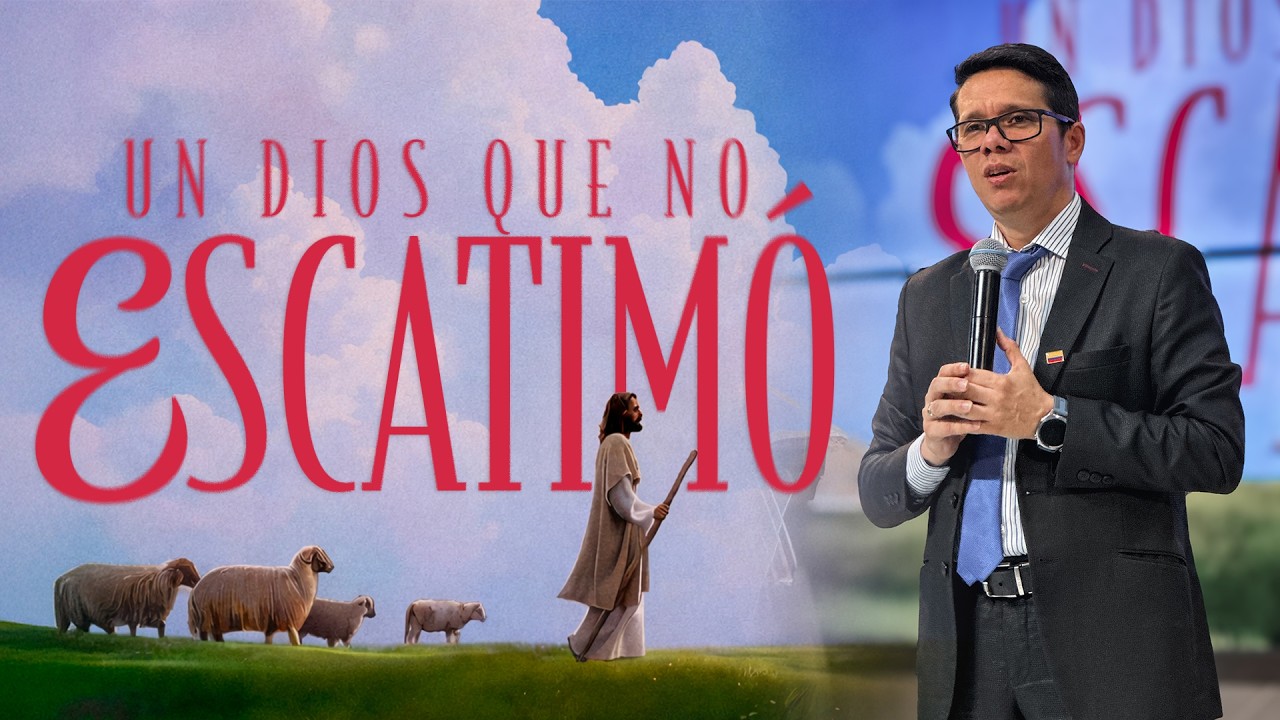
A GOD WHO DID NOT SPARE
Base Text: Romans 8:32
"He who did not spare his own Son, but gave him up for us all—how will he not also, along with him, graciously give us all things?" (Romans 8:32 NIV)
INTRODUCTION
I read a book by a well-known writer in the biblical world, titled "The Prodigal God". Some have criticized him for using that word which the Reina Valera 1960 version titled for the Parable of Luke 15 as "The Prodigal Son", where the popular connotation is given to a young man who spent and squandered everything.
Prodigal is an expression that comes from the Latin "prodigus". Listen well: it is Latin, it was not even in Greek — because the parable was written in Greek. It is a term used in Spanish to describe this story.
But the biblical parables have more the purpose of showing the character of God. The term says: "someone who squanders, who spends without measure, without wisdom". But I want to give the emphasis of what this author and of what the Lord Himself wanted to present of the divine nature:
A God who gives without limit. A God who does not spare.
I. DID NOT SPARE — Romans 8:32
"He who did not spare his own Son, but gave him up for us all—how will he not also, along with him, graciously give us all things?" (Romans 8:32)
This verse presents God as someone who is willing to do everything.
The key word: φείδομαι (pheidomai)
The word to spare in Greek is φείδομαι (pheidomai), which means to avoid. That is, God did not avoid giving the most valuable thing. But it has a root in Greek φειδομένως (pheidomenōs), which means sparingly (2 Corinthians 9:6).
The synonyms of sparing are: haggling, limited, scarce, stingy.
Haggling is a term used for a stingy person, who wants everything very cheap, almost given away. The scarce person is stingy.
But it says that God is not like that. He is not stingy. He is not a haggler. For which the expression "Prodigal God" speaks of a God who gives abundantly, who is supremely generous. God is unlimited.
Abundantly: πλουσίως (plousios)
"...whom he poured out on us generously through Jesus Christ our Savior, so that, having been justified by his grace, we might become heirs having the hope of eternal life." (Titus 3:5-7 NIV)
The word abundantly in Greek is said πλουσίως (plousios), which means "extremely generous".
Look for the word "abundantly" and there are many verses in the Bible of how God gives, blesses, enriches. He is extremely generous. God is not like man — He is not a stingy, ungenerous person.
II. THE CHARACTER OF THE FATHER
A. God was not scarce with man
God gave his Son to die for our sins. He didn't stop. When remembering the story of Abraham (Genesis 22), who was capable of almost offering his son regardless of the consequences, we see a reflection of what God did: He offered his Son as a sacrifice for the forgiveness of humanity.
The world denigrates God, but He in his great love insists, works, uses men here and there, seeks you so that you may know Him, return to the fold, or so that we may serve Him. Without any measure.
In many ways God gives Himself. There are no limitations when trying to keep you from going to hell. That you may accept salvation. That you may accept His extreme blessing.
B. The Parable of the Generous Father — Luke 15:11-32
We see the story of a son who asked for the inheritance and went and squandered, spent until he was bankrupt. There is a limit in humanity.
The older son — an ungrateful someone who was not happy.
But the Father — this generous man — gave the inheritance without having the obligation. Just as God gave man to enjoy everything.
The party without reproach
When the son returned, the father threw a party without any reproach:
"But the father said to his servants, ‘Quick! Bring the best robe and put it on him. Put a ring on his finger and sandals on his feet. Bring the fattened calf and kill it. Let’s have a feast and celebrate. For this son of mine was dead and is alive again; he was lost and is found.’ So they began to celebrate." (Luke 15:22-24 NIV)
The Father gave him:
- New robe — new identity
- Ring — restored authority
- Sandals — dignity of a son, not a slave
- Fattened calf — the best provision
- Threw a party — celebration without reservations
What God would do because you accept his forgiveness, his love, his mercy — is a God of extravagance. He did not spare his Son, how much more would He give us everything!
The promise to Israel
When God led Israel, He told them:
"But I said to you, “You will possess their land; I will give it to you as an inheritance, a land flowing with milk and honey.” I am the Lord your God, who has set you apart from the nations." (Leviticus 20:24 NIV)
C. The ungrateful son — Luke 15:25-31
"Meanwhile, the older son was in the field. When he came near the house, he heard music and dancing... 'Look! All these years I’ve been slaving for you and never disobeyed your orders. Yet you never gave me even a young goat so I could celebrate with my friends. But when this son of yours who has squandered your property with prostitutes comes home, you kill the fattened calf for him!' 'My son,' the father said, 'you are always with me, and everything I have is yours.'" (Luke 15:25-31 NIV)
This son represents the religious — and therefore, us. Many times the one who is in the house thinks his father is stingy, but forgets that God has everything to offer you.
He is a Father who does not compare to you or me:
"Which of you, if your son asks for bread, will give him a stone? Or if he asks for a fish, will give him a snake? If you, then, though you are evil, know how to give good gifts to your children, how much more will your Father in heaven give good gifts to those who ask him!" (Matthew 7:9-11 NIV)
The confronting truth
You have nothing because you don't know how to ask. Because you distrust God. Because you think God is like you: stingy, a haggler, needy. No — He is extremely generous.
"However, as it is written: “What no eye has seen, what no ear has heard, and what no human mind has conceived” — the things God has prepared for those who love him." (1 Corinthians 2:9 NIV)
There are children who live in the house, eat, receive everything and live embittered. They have not known God's extravagance. God does not spare anything — He spends it all, although He is not limited, because He owns everything.
The seed continues to bear fruit. His word continues to work. God loves us in an unlimited way. God does not invest in something He sees will not yield profit — He places seed where there can be profit.
CONCLUSION
"A generous person will prosper; whoever refreshes others will be refreshed." (Proverbs 11:25 NIV)
If I wish to prosper in my soul, I must not store up my provisions, but distribute to the poor. Being stingy and tight-fisted is the world's way to prosperity, but it is not God's way, for He says:
"One person gives freely, yet gains even more; another withholds unduly, but comes to poverty." (Proverbs 11:24 NIV)
The winning way of faith is to give. I must try this over and over again; and I can expect to receive as much prosperity as is good for me.
I cannot have the certainty of becoming rich. I will prosper, but not too much. Too much wealth could make me heavy, cause the indigestion of worldliness. No, if I have enough to be healthy, I can consider myself satisfied.
But there is a mental and spiritual fatness that I greatly ambition: and this comes as a result of generous thoughts towards God, his church and my fellow men.
I must not spare, so that my heart does not starve. I must be liberal and generous, for thus I shall be like my Lord. He gave Himself for me: should I spare Him anything?
REFLECTION QUESTIONS
-
Do you see God as a generous Father or as a stingy God who spares His blessings?
-
Do you identify more with the prodigal son who returned or with the older son who lived embittered in the house?
-
Are there areas in your life where you distrust God's provision?
-
Are you being generous as a reflection of your heavenly Father's character?
-
What would it mean for you to live believing that God does not spare anything?
Outline by Pastor Josué Angarita — MMM Portal Campestre Church, Girón, Santander, Colombia.